The Election Changed Washington. Will It Change Factory-Built Housing?
What the 2026 midterms could mean for HUD Code manufactured housing and IRC modular construction in the near term and long term. The political landscape has shifted. The question is whether factory-built housing is positioned to take advantage of it.
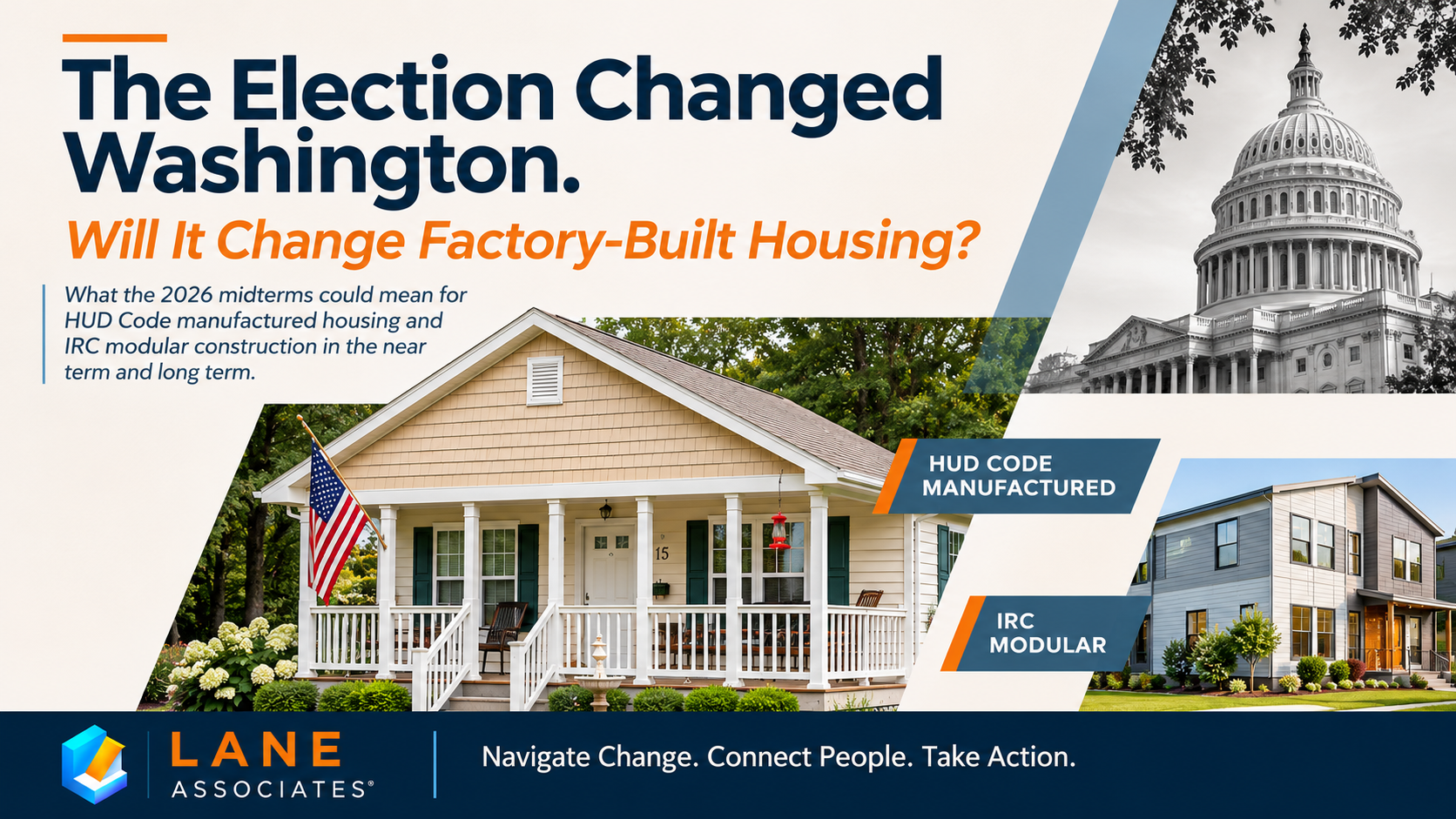
The Election Changed Washington. Will It Change Factory-Built Housing?
By Chris "Lane" Nicely | November 10, 2026
What the 2026 midterms could mean for HUD Code manufactured housing and IRC modular construction in the near term and long term.
The 2026 midterm elections are over. The results have shifted the balance of power in Washington, and the policy conversations that follow will shape the legislative and regulatory environment for housing, including factory-built housing, for the next several years.
The question for our industry is not simply what changed. It is whether we are positioned to take advantage of it.
Two Products. One Opportunity.
Factory-built housing is not a single product. It is a category that includes two distinct regulatory frameworks, each with its own opportunities and challenges in the current political environment.
HUD Code manufactured housing is federally regulated under the National Manufactured Housing Construction and Safety Standards Act. Every HUD Code home, regardless of where it is built or where it is placed, must meet federal construction and safety standards administered by the Department of Housing and Urban Development. This federal preemption is both a strength and a constraint. It creates national consistency, but it also means that changes to the regulatory environment at the federal level have direct and immediate consequences for the product.
IRC modular construction is built to the International Residential Code and regulated at the state level. Modular homes are inspected in the factory and arrive at the site with a state-issued insignia of approval. Because modular is state-regulated, the federal policy environment affects it primarily through financing, zoning, and land use policy rather than through direct construction standards.
Both products stand to benefit from a more favorable federal housing policy environment. But the pathways are different, and the industry needs to understand both.
What a Shifted Congress Could Mean
Every election cycle produces predictions about what the new Congress will prioritize. Housing affordability has emerged as a rare area of bipartisan concern, driven by constituent pressure in virtually every congressional district in the country. That does not guarantee legislative action, but it does create a more favorable environment for housing-related proposals than the industry has seen in some time.
Several policy areas are worth watching closely.
Federal Zoning and Land Use Reform
Zoning restrictions remain one of the most significant barriers to manufactured housing placement in desirable markets. Exclusionary zoning, minimum square footage requirements, aesthetic standards that effectively prohibit HUD Code homes, and outright bans on manufactured housing in residential zones all limit where our product can be placed and who can access it.
Federal efforts to incentivize local zoning reform, through grant programs, infrastructure funding conditions, or direct legislative action, have gained traction in recent years. A Congress focused on housing affordability has reason to continue and expand those efforts. The manufactured housing industry should be at the table for every one of those conversations, making the case that zoning reform without manufactured housing is incomplete.
HUD Code Regulatory Environment
The HUD Code regulatory environment is shaped significantly by the administration and the leadership of HUD's Office of Manufactured Housing Programs. Changes in congressional oversight priorities, appropriations, and administrative appointments all affect how the program operates in practice.
The industry's priorities in this area are well established: streamlined installation standards, updated energy efficiency requirements that reflect current technology rather than outdated assumptions, and a dispute resolution process that works for both manufacturers and consumers. A more engaged Congress creates opportunities to advance these priorities through oversight hearings, appropriations riders, and direct legislation.
Financing Reform
Personal property lending for manufactured homes remains the most persistent structural barrier to expanding homeownership access through factory-built housing. Interest rates are higher, terms are shorter, and lender participation is more limited than in the conventional mortgage market. The result is a monthly payment burden that undermines the affordability advantage our product should provide.
Legislative and regulatory action to improve personal property lending, whether through the Consumer Financial Protection Bureau, the Federal Housing Finance Agency, or direct congressional action, requires sustained advocacy. A Congress focused on housing affordability has both the motivation and the political cover to act. The industry needs to provide the data, the policy proposals, and the constituent stories that make that action possible.
Energy Efficiency and Climate Policy
Energy efficiency standards for manufactured housing have been a source of ongoing tension between the industry and federal regulators. The HUD Code's energy provisions have not kept pace with advances in building science, and updated standards have been proposed, debated, and delayed for years.
The political environment for energy efficiency policy is always complex, but the underlying case for updating manufactured housing energy standards is strong: lower utility costs directly improve housing affordability for residents, and modern factory-built construction is capable of delivering energy performance that rivals or exceeds site-built alternatives. The industry should engage this conversation proactively rather than reactively.
The Near-Term Outlook
In the near term, the most significant impact of the midterm results will be felt in the appropriations process and in the regulatory posture of federal agencies.
Congressional oversight of HUD, the CFPB, the FHFA, and other agencies with jurisdiction over manufactured housing will shift with the new committee assignments and leadership. The industry should be monitoring those changes closely and engaging with new committee staff and members who may not yet have a deep understanding of factory-built housing.
The appropriations process will determine funding levels for HUD's manufactured housing programs, for rural housing programs administered by the USDA, and for community development programs that support affordable homeownership. These funding decisions have direct consequences for the communities and buyers our industry serves.
The Long-Term Opportunity
The long-term opportunity is larger, and it depends less on any single election than on the industry's ability to build durable relationships with policymakers across the political spectrum.
Housing affordability is not a partisan issue. The shortage of attainable homes affects Republican and Democratic constituencies alike. Rural communities, suburban markets, and urban neighborhoods all face versions of the same challenge: not enough homes at prices that working families can afford.
Factory-built housing is the most scalable solution to that challenge that currently exists. HUD Code manufactured homes and IRC modular construction together represent a production capacity, a cost structure, and a quality level that the conventional construction industry cannot match at the price points where demand is greatest.
Making that case, consistently and credibly, to every policymaker who has jurisdiction over housing, zoning, financing, or land use is the long-term work of the industry. Elections change the roster. The work continues regardless.
What the Industry Should Do Now
The weeks following an election are among the most important for policy engagement. New members are forming their priorities. Returning members are reassessing their committee assignments and legislative agendas. Staff transitions create both challenges and opportunities.
The manufactured housing industry should be taking several concrete steps right now.
Engage new members and their staff. Many of the members elected or re-elected in 2026 do not yet have a working understanding of factory-built housing. That is an opportunity, not an obstacle. A well-prepared briefing, a factory tour, or a visit to a completed project can establish a relationship and a frame of reference that shapes how a member thinks about housing policy for years.
Reconnect with returning members. Election cycles disrupt relationships. Returning members who have been focused on their campaigns need to be re-engaged on the policy priorities that matter to the industry.
Prepare for the appropriations process. The funding decisions made in the next appropriations cycle will affect HUD's manufactured housing programs, rural housing programs, and community development initiatives. The industry needs to be present and prepared for those conversations.
Advance specific, actionable proposals. Broad advocacy for "better policy" is less effective than specific, well-documented proposals that policymakers can act on. The industry should arrive at every policy conversation with a clear ask, supporting data, and a realistic path to implementation.
Tell the story of what factory-built housing delivers. Policy is ultimately shaped by stories as much as by data. The industry needs to be telling the stories of the families who own manufactured homes, the communities that have been revitalized by factory-built construction, and the developers and municipalities that have found in our product a solution to challenges that conventional construction could not address.
The Election Changed Washington
The election changed Washington. Whether it changes factory-built housing depends on what the industry does next.
The policy environment is more favorable than it has been in some time. The demand for attainable homeownership has never been greater. The product, in both its HUD Code and IRC modular forms, has never been better.
What is needed now is the engagement, the preparation, and the sustained advocacy that converts a favorable environment into durable policy progress.
Navigate change. Connect people. Take action.
Chris "Lane" Nicely is President & CEO of LANE Associates, an off-site housing consulting firm based in Dallas, TX. With more than 30 years of experience in manufactured and factory-built housing, he works with manufacturers, developers, nonprofits, and municipalities to advance attainable homeownership across the country. Reach him at chrisnicely@laneassociatesus.com.
Explore Topics
Written by
Chris "Lane" Nicely
Content creator and writer sharing insights and stories.