2027: A Breakout Opportunity for Manufactured Housing
Order momentum is rising, affordability pressure is intensifying, and the policy environment is shifting. Here is why 2027 may be the most important year factory-built housing has seen in a generation, and what the industry must do to capture it.
2027: A Breakout Opportunity for Manufactured Housing
By Chris "Lane" Nicely | November 6, 2026
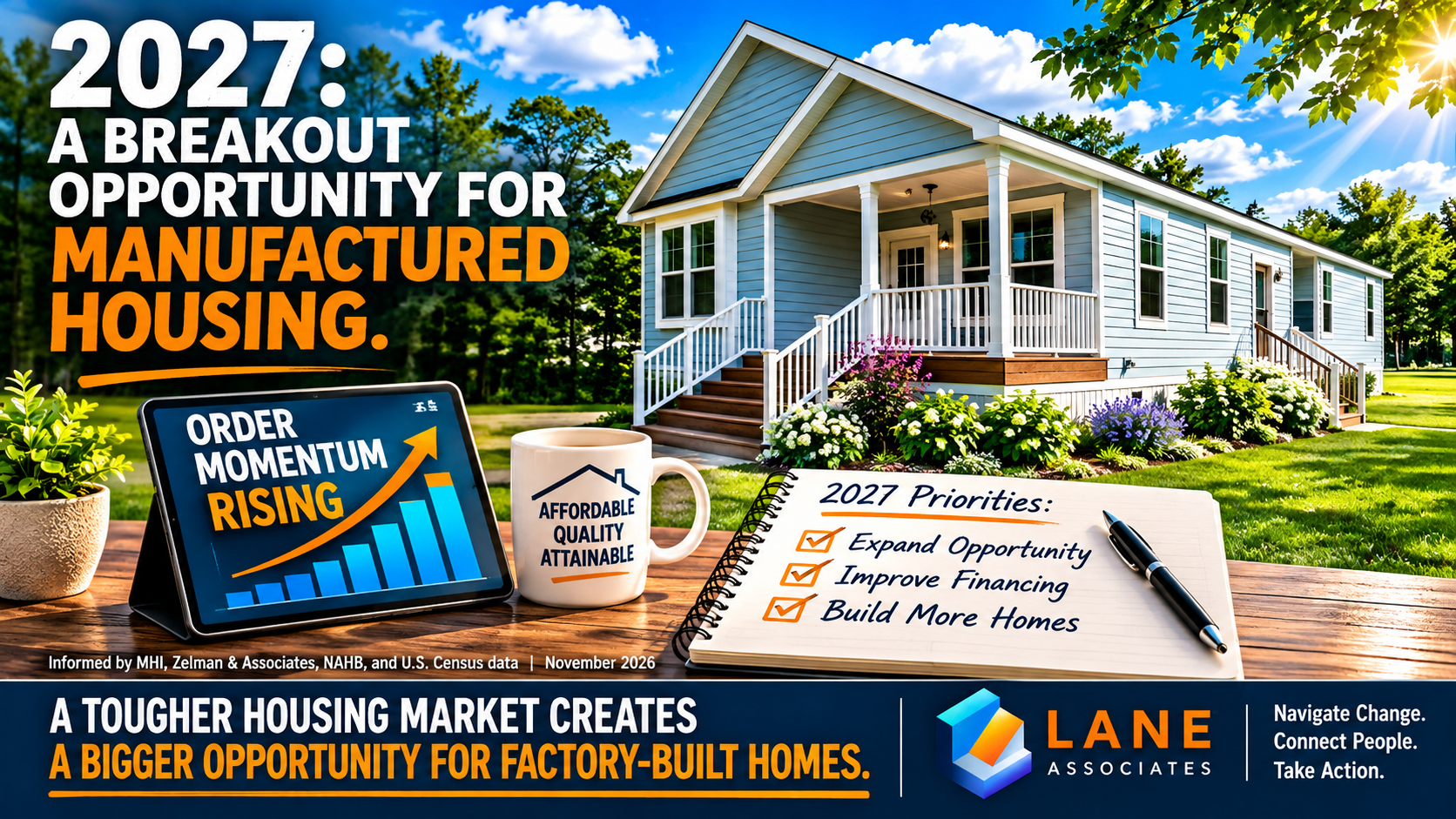
A tougher housing market creates a bigger opportunity for factory-built homes.
That is not a slogan. It is a conclusion drawn from the data, the trends, and the conversations happening right now across the manufactured housing industry. Informed by research from MHI, Zelman & Associates, NAHB, and the U.S. Census Bureau, the picture emerging for 2027 is one of rising order momentum, intensifying affordability pressure, and a policy environment that is finally beginning to move in our direction.
The question is whether our industry is ready to meet the moment.
The Market Conditions Are Aligning
For years, manufactured housing advocates have argued that when conventional housing becomes unaffordable, factory-built homes become the logical alternative. That argument has never been more relevant than it is today.
Mortgage rates remain elevated. Site-built home prices have not meaningfully corrected in most markets. The gap between what American families can afford and what the conventional market offers continues to widen. And yet, the response from the broader housing industry has been slow, incremental, and largely insufficient.
Manufactured housing does not have that luxury, and it does not need it. We already build affordable, quality, attainable homes. We have the production capacity, the distribution networks, and the workforce to scale. What we need is the will to act, and the strategy to act effectively.
Order momentum is rising. That is not a projection, it is a current market signal. The industry should treat it as a starting gun.
Three Priorities for 2027
The path forward is not complicated, but it does require discipline and coordination across every segment of the industry. Three priorities stand above the rest.
1. Expand Opportunity
Manufactured housing cannot grow by serving only the markets it has always served. Land-lease communities, rural homesites, and traditional retail sales remain essential, but they are not sufficient to capture the full opportunity that 2027 presents.
Urban infill, scattered-site development, nonprofit partnerships, and municipal redevelopment initiatives are all areas where factory-built homes can compete, and win, if the industry shows up prepared. Recent projects in Kansas City, Phoenix, San Bernardino, and other markets have demonstrated that manufactured homes can anchor neighborhood revitalization efforts when the right partnerships are in place.
Expanding opportunity means identifying the next 10, 20, and 50 municipalities where those partnerships can be built. It means manufacturers designing homes for specific applications, not just general retail. It means retailers developing relationships with developers, contractors, and housing agencies that have never worked with factory-built construction before.
The opportunity is there. The industry has to go get it.
2. Improve Financing
Nothing limits manufactured housing's potential more consistently than financing. The gap between what is available for site-built homes and what is available for HUD Code homes, particularly personal property loans, remains one of the most significant structural barriers our industry faces.
Progress is being made. Fannie Mae's MH Advantage and Freddie Mac's CHOICEHome programs have expanded access to conventional financing for qualifying CrossMod and site-built-comparable manufactured homes. But these programs reach only a fraction of the market.
The broader challenge is personal property lending, where interest rates are higher, terms are shorter, and lender participation is limited. Addressing this requires sustained engagement with federal housing finance agencies, lenders, and policymakers, not occasional advocacy, but consistent, data-driven pressure for structural change.
Improving financing also means educating buyers, real estate professionals, and appraisers about what is available today. Too many transactions fail not because financing does not exist, but because the people involved do not know how to find it or structure it correctly.
3. Build More Homes
This may seem obvious, but it deserves to be stated plainly: the industry needs to build more homes.
Not just more of the same homes, in the same configurations, for the same markets. More homes designed for the full range of buyers and communities that need them. More homes that meet the design, performance, and financing standards that open new markets. More homes that demonstrate, project by project and neighborhood by neighborhood, that factory-built construction is not a compromise, it is a solution.
Production capacity exists. The challenge is deploying it strategically, in response to documented market demand, with the partnerships and financing structures in place to ensure that homes reach buyers who need them.
What the Data Is Telling Us
The research base for this outlook draws on multiple authoritative sources.
MHI's shipment data and market analysis confirm that order momentum is building heading into 2027. Zelman & Associates' housing market research points to continued affordability pressure in conventional markets, with no near-term relief in sight. NAHB's builder sentiment data reflects a conventional construction industry that is constrained by labor costs, land prices, and regulatory burden. And U.S. Census Bureau data on household formation, income distribution, and housing cost burden all point to a sustained, structural demand for attainable homeownership that manufactured housing is uniquely positioned to address.
These are not isolated signals. They are a convergent picture of a market that needs what we build.
The Role of Leadership
Data and market conditions create opportunity. Leadership converts opportunity into outcomes.
The manufactured housing industry has no shortage of talented, committed professionals at every level, from factory floors to executive suites, from community managers to state association directors. What the industry needs in 2027 is for those professionals to act with a shared sense of urgency and a common strategic direction.
That means manufacturers investing in product development for new markets. Retailers building relationships beyond their traditional customer base. Community owners sharing their operational expertise with new development partners. State associations expanding their municipal education efforts. Lenders and appraisers deepening their knowledge of factory-built products and programs.
And it means all of us, collectively, telling a better story about what manufactured housing is, what it delivers, and why it matters.
A Tougher Market Is Our Moment
Every market cycle creates winners and losers. The winners are not always the largest or the best-capitalized. They are the ones who recognize the moment, prepare for it, and move decisively when it arrives.
The conventional housing market's challenges are manufactured housing's opportunity. Rising order momentum confirms that buyers are already responding. The question is whether the industry will meet that demand with the product, the financing, the partnerships, and the strategy it deserves.
2027 is not a distant horizon. It is the next chapter, and it is being written right now.
Navigate change. Connect people. Take action.
Chris "Lane" Nicely is President & CEO of LANE Associates, an off-site housing consulting firm based in Dallas, TX. With more than 30 years of experience in manufactured and factory-built housing, he works with manufacturers, developers, nonprofits, and municipalities to advance attainable homeownership across the country. Reach him at chrisnicely@laneassociatesus.com.
Explore Topics
Written by
Chris "Lane" Nicely
Content creator and writer sharing insights and stories.