The 21st Century ROAD to Housing Act Could Mark a Turning Point for Manufactured Housing
One of the most significant bipartisan housing bills in a generation recognizes what our industry has known for years: factory-built housing must be part of the solution.
The 21st Century ROAD to Housing Act Could Mark a Turning Point for Manufactured Housing
By Chris "Lane" Nicely, President & CEO, LANE Associates
The United States has spent decades searching for meaningful solutions to its housing affordability crisis. While many policy discussions have focused on subsidies, zoning, or interest rates, one of the most significant bipartisan housing bills in a generation recognizes something our industry has known for years: factory-built housing, and particularly HUD Code manufactured homes, must be part of the solution.
A Bipartisan Moment
The passage of the 21st Century ROAD to Housing Act represents something genuinely rare in today's political environment: meaningful bipartisan agreement on a major domestic policy issue.
The bill drew support from both sides of the aisle because the housing affordability crisis has become impossible to ignore. In communities across the country, rural and urban, red and blue, working families are being priced out of homeownership. The median home price has more than doubled in many markets over the past decade. Rental costs have followed. The gap between what families can afford and what the market offers has never been wider.
Against that backdrop, manufactured housing's value proposition is hard to argue with. A HUD Code manufactured home can be produced at a fraction of the cost of comparable site-built construction, delivered in weeks rather than months, and placed in communities across the country. The technology is proven. The regulatory framework exists. The industry has the capacity to scale.
What's been missing is the policy infrastructure to support that scaling. The ROAD to Housing Act is a significant step toward building that infrastructure.
Key Provisions and Their Significance
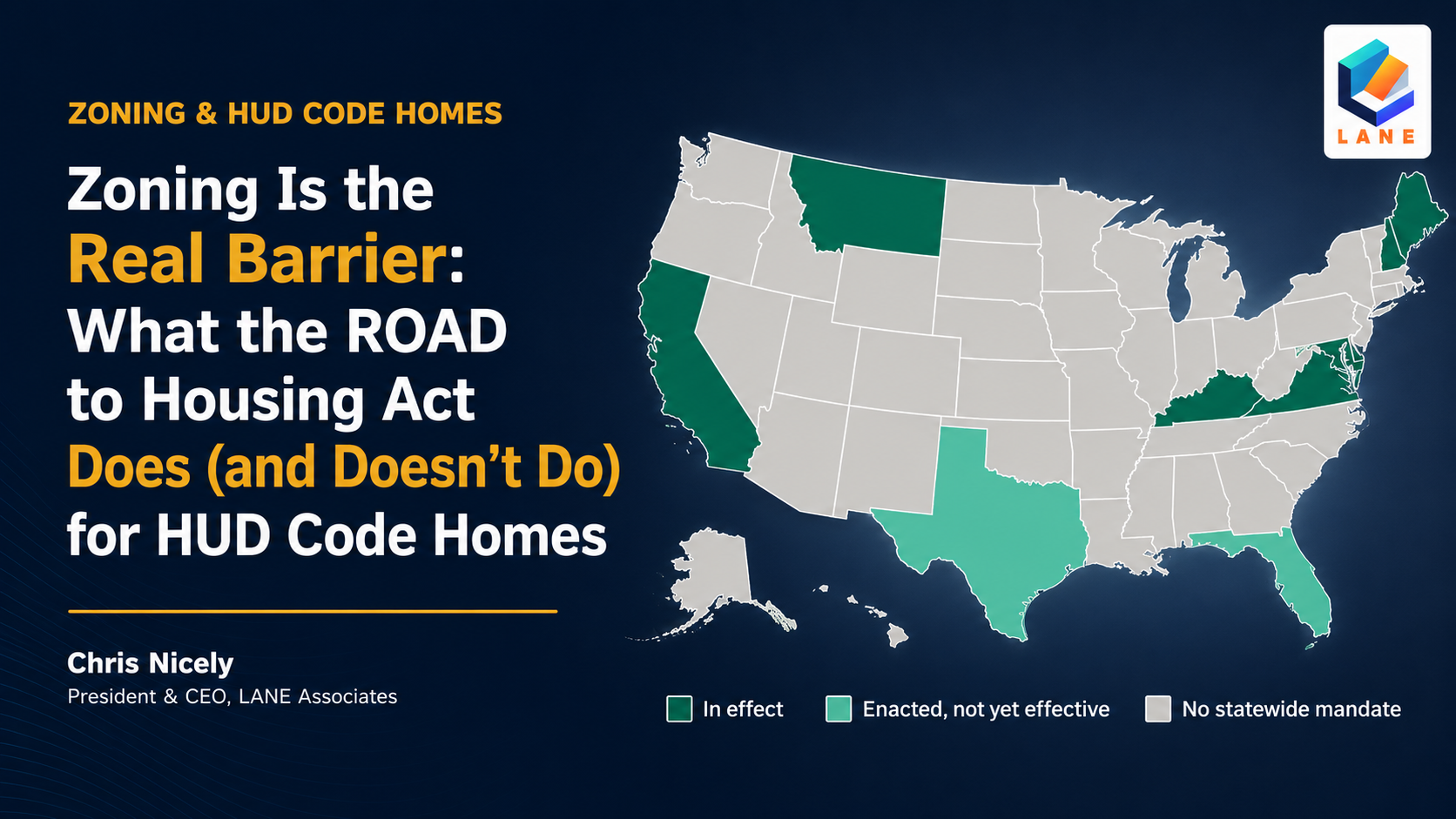
Zoning reform incentives. The Act creates financial incentives for states and localities that adopt zoning policies more permissive of manufactured housing placement. This is perhaps the most important provision, because zoning exclusion has been the single biggest barrier to expanding manufactured housing access.
For decades, local governments have used zoning, sometimes explicitly, sometimes through facially neutral regulations, to keep manufactured homes out of residential neighborhoods. The ROAD to Housing Act doesn't eliminate local zoning authority, but it creates real financial motivation for reform. That's a meaningful shift.
Financing improvements. The Act includes provisions designed to improve access to conventional mortgage financing for manufactured homes, including measures to encourage Fannie Mae and Freddie Mac to expand their manufactured housing programs.
This matters enormously. The financing gap between manufactured housing and site-built housing has been one of the most persistent barriers to expanding the market. Buyers who can qualify for a conventional mortgage on a site-built home often can't access comparable financing for a manufactured home, which means they pay higher rates, face shorter loan terms, and build equity more slowly.
Closing that gap won't happen overnight, but the ROAD to Housing Act creates a framework for progress.
Consumer protections. The Act includes meaningful protections for residents of manufactured home communities, particularly around lot rent increases and community sales. This is important for maintaining the existing stock of affordable manufactured housing, not just expanding new production.
Research and data. The Act funds expanded research on manufactured housing markets, financing, and resident outcomes. Better data will support better policy, and will help counter the persistent myths and misconceptions that have historically hampered the industry's advocacy efforts.
What This Means for the Industry
For manufacturers, dealers, community operators, and the broader ecosystem of organizations working in manufactured housing, the ROAD to Housing Act creates both opportunity and responsibility.
The opportunity is real. Federal policy is moving in a direction that supports manufactured housing expansion. Financing access is improving. Zoning reform is gaining momentum at the state and local level. The conditions for growth are better than they've been in years.
The responsibility is equally real. The industry has an opportunity to demonstrate that manufactured housing can be a high-quality, community-integrated solution to the affordability crisis, not just a cheap alternative. That means investing in design and aesthetics. It means engaging seriously with community development organizations and affordable housing advocates. It means being present in the policy conversations that will shape the next decade.
The Longer View
I've been working in and around the manufactured housing industry for more than three decades. I've seen the industry at its best, innovative, responsive, genuinely committed to expanding housing access, and I've seen it at its worst, defensive, insular, resistant to change.
The passage of the ROAD to Housing Act is a moment that calls for the industry at its best.
The housing affordability crisis is real, it's urgent, and it's not going away. Factory-built housing has a genuine role to play in addressing it. But realizing that potential requires more than good policy, it requires an industry that's ready to step up, engage seriously with the communities it serves, and demonstrate through action that manufactured housing is a solution worth investing in.
I believe the industry is ready. The ROAD to Housing Act gives us a better road to travel. Now it's time to drive.
Chris "Lane" Nicely is President & CEO of LANE Associates, a consulting firm specializing in manufactured, modular, and off-site built housing strategy. Contact Lane at chrisnicely@laneassociatesus.com or 865.385.9675.
Explore Topics
Written by
Chris "Lane" Nicely
Content creator and writer sharing insights and stories.