The First-Time Buyer Has Changed. Factory-Built Housing Must Change With Them.
The first-time homebuyer of 2026 is older, more diverse, more financially constrained, and more skeptical than any previous generation. Factory-built housing has the product to serve them, but only if the industry adapts its design, financing, marketing, and access strategies to meet buyers where they actually are.
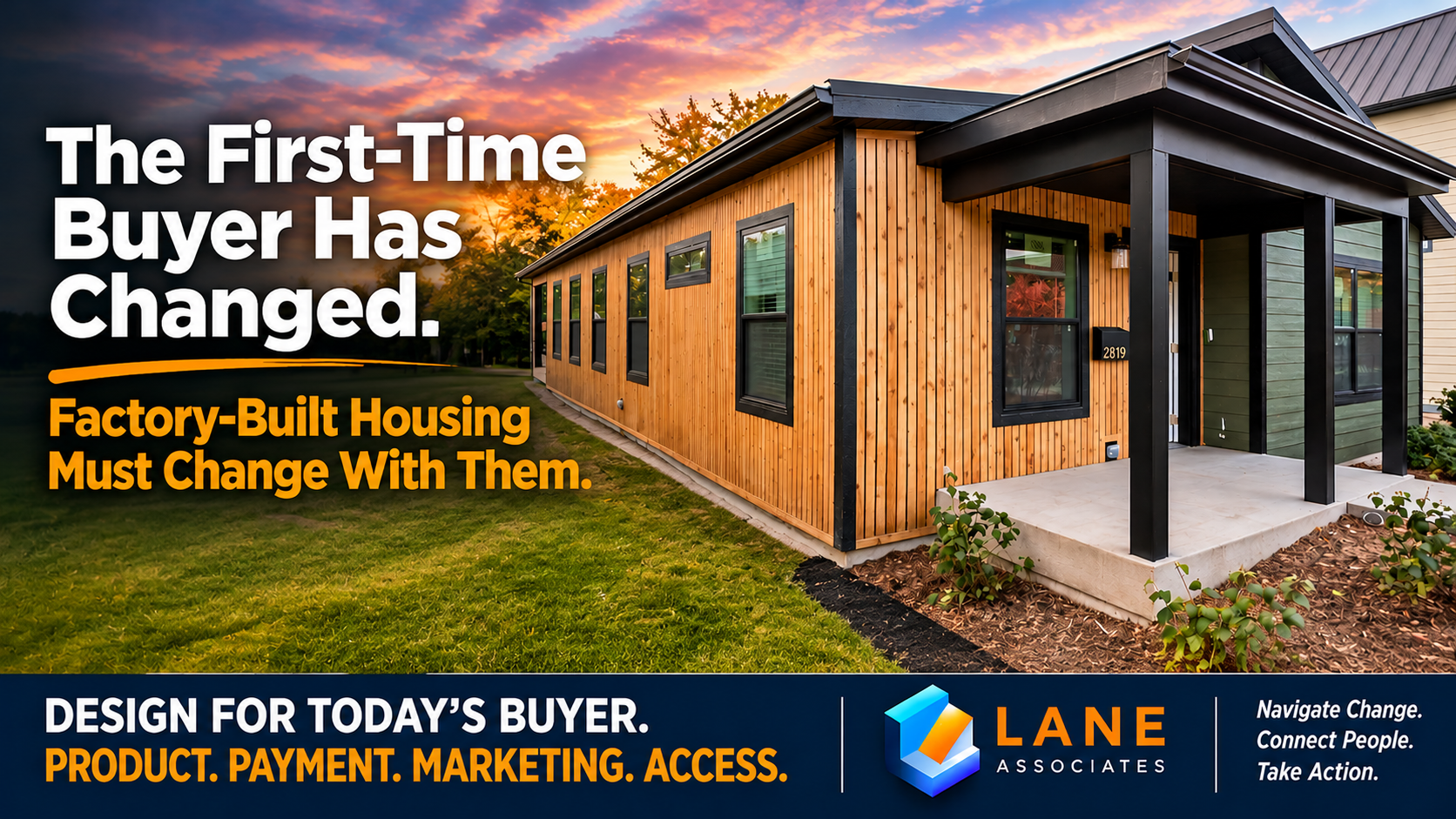
The First-Time Buyer Has Changed. Factory-Built Housing Must Change With Them.
By Chris "Lane" Nicely | November 10, 2026
The first-time homebuyer has changed.
Not slightly. Not gradually. Fundamentally.
The buyer entering the housing market today is older, more diverse, more financially constrained, and more skeptical of traditional homeownership pathways than any previous generation of first-time buyers. They carry student debt. They have delayed household formation. They have watched housing prices outpace their income growth for a decade. And they are making purchasing decisions in a market defined by elevated mortgage rates, limited inventory, and a conventional housing industry that was not designed with them in mind.
Factory-built housing has the product to serve this buyer. The question is whether the industry has the strategy.
Who the First-Time Buyer Is Today
The median age of a first-time homebuyer has risen to 38, according to the National Association of Realtors, up from 29 in the 1980s. That is not a rounding error. It represents a decade of delayed entry into homeownership, driven by student loan burdens, wage stagnation relative to home prices, and a rental market that has absorbed an entire generation of would-be buyers.
Today's first-time buyer is also more likely to be a single woman, a person of color, or a member of a multigenerational household than at any previous point in the modern housing market. Their priorities are different. Their financial profiles are different. Their expectations for what a home should look like, where it should be located, and how it should be purchased are different.
And yet, much of the manufactured housing industry continues to market, design, and finance homes as if the buyer profile has not changed since 1995.
That is a strategic error the industry cannot afford to repeat.
Four Areas Where Factory-Built Housing Must Adapt
The path forward requires honest assessment across four interconnected areas: product, payment, marketing, and access. Each one matters. None of them works in isolation.
Product: Design for the Buyer Who Is Actually There
Today's first-time buyer is not looking for the largest home they can afford. They are looking for the right home, in the right location, at a price that works within their actual financial reality.
That means smaller footprints, thoughtfully designed. It means open floor plans that accommodate remote work. It means energy-efficient construction that reduces monthly operating costs, not just purchase price. It means exterior design that fits established neighborhoods, not just rural homesites or land-lease communities.
CrossMod homes have demonstrated that factory-built construction can deliver this product. But CrossMod is not the only answer, and it does not reach every market or every buyer. The broader industry needs to expand its design vocabulary, develop homes for specific buyer profiles and specific community contexts, and stop treating "affordable" as a synonym for "minimal."
The first-time buyer of 2026 has high expectations. They have grown up with design-forward products in every other category of their lives. A manufactured home that looks and feels like a compromise will not win their business, regardless of price.
Payment: Financing Is Still the Ceiling
Price matters. But payment is what actually determines whether a buyer can close.
This is where factory-built housing faces its most persistent structural challenge. Personal property loans, which finance a significant share of manufactured home purchases, carry higher interest rates, shorter terms, and more limited lender participation than conventional mortgage products. The result is a monthly payment that often exceeds what the purchase price alone would suggest, and a financing experience that feels more like a consumer loan than a home purchase.
For a first-time buyer already managing student debt, limited savings, and a tight monthly budget, this gap is often decisive.
Progress is being made. Fannie Mae's MH Advantage and Freddie Mac's CHOICEHome programs have expanded conventional financing access for qualifying homes. The USDA and FHA programs serve rural and lower-income buyers in ways that conventional lending does not. But these programs reach only a fraction of the buyers who need them, and the personal property lending market remains structurally disadvantaged compared to site-built alternatives.
The industry needs to advocate more aggressively for financing reform, educate buyers and real estate professionals about available programs, and work with lenders to develop products that reflect the actual risk profile of manufactured home loans, not outdated assumptions about depreciation and default.
Payment is not a secondary concern. For the first-time buyer of 2026, it is often the primary one.
Marketing: Meet the Buyer Where They Are
The first-time buyer of 2026 does not walk into a retail sales center because they drove past it on the highway. They research online, compare options across platforms, watch video content, read reviews, and form opinions about products and brands long before they ever speak to a salesperson.
The manufactured housing industry's marketing infrastructure has not kept pace with this reality.
Too many manufacturers and retailers rely on marketing approaches built for a previous generation of buyers, approaches that emphasize price over value, features over lifestyle, and product specifications over the story of what homeownership actually means for a family.
Today's first-time buyer responds to authenticity. They want to see real homes, real families, and real communities. They want to understand what it actually feels like to own a factory-built home, not just what it costs. They want to see themselves in the marketing, which means the industry needs to reflect the diversity of the buyers it is trying to reach.
Digital marketing, social media, content strategy, and community-based outreach are not optional extras for a modern housing brand. They are the primary channels through which today's first-time buyer forms their understanding of what is possible.
Access: Remove the Barriers Between the Buyer and the Home
Even when the product is right, the payment is workable, and the marketing is effective, first-time buyers still face structural barriers that prevent them from completing a purchase.
Zoning restrictions limit where manufactured homes can be placed. Land availability in desirable locations is constrained. The process of finding a site, securing financing, ordering a home, coordinating installation, and completing a purchase is fragmented, confusing, and often requires a level of knowledge and persistence that first-time buyers, by definition, do not yet have.
The industry needs to reduce this friction.
That means developing turnkey solutions that guide buyers through the full process, not just the sale. It means partnering with municipalities, nonprofits, and community development organizations to create pathways to homeownership that do not require buyers to navigate a complex system on their own. It means investing in buyer education, not as a sales tactic, but as a genuine service.
Access is not just about geography. It is about whether the path from "I want to buy a home" to "I own a home" is clear, navigable, and achievable for a buyer who has never done it before.
The Opportunity Is Real
None of this is theoretical. The first-time buyer market is large, it is growing, and it is underserved by the conventional housing industry in ways that factory-built housing is uniquely positioned to address.
The affordability gap between what first-time buyers can afford and what the conventional market offers has never been wider. The demand for attainable homeownership has never been more urgent. And the factory-built housing industry has never had a better opportunity to demonstrate that it can deliver the product, the payment, the marketing, and the access that today's buyer needs.
But opportunity does not convert itself into outcomes. That requires strategy, investment, and a willingness to change.
The first-time buyer has changed. The industry that serves them must change with them.
Design for today's buyer. Product. Payment. Marketing. Access.
Navigate change. Connect people. Take action.
Chris "Lane" Nicely is President & CEO of LANE Associates, an off-site housing consulting firm based in Dallas, TX. With more than 30 years of experience in manufactured and factory-built housing, he works with manufacturers, developers, nonprofits, and municipalities to advance attainable homeownership across the country. Reach him at chrisnicely@laneassociatesus.com.
Explore Topics
Written by
Chris "Lane" Nicely
Content creator and writer sharing insights and stories.